


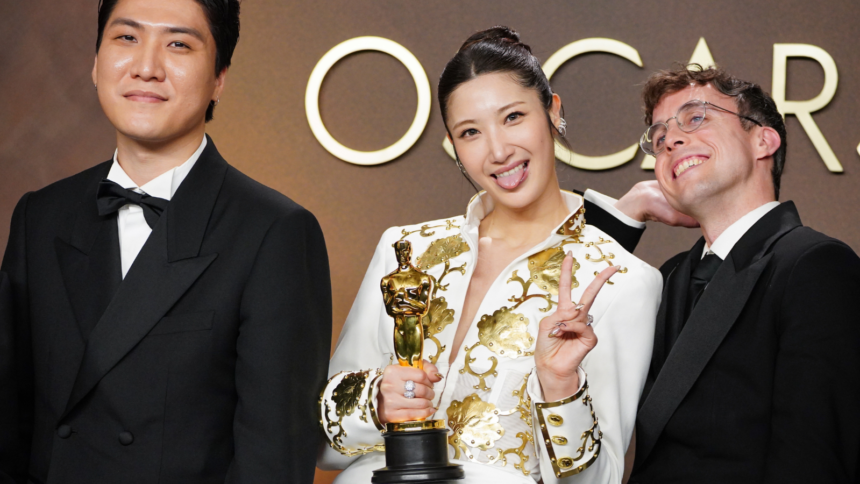
The 98th Academy Awards on March 15, 2026, delivered one of the most memorable and bittersweet moments of the night when “Golden” from Netflix’s animated hit KPop Demon Hunters became the first K-pop song ever to win Best Original Song.
The victory was a landmark for K-pop’s growing influence in global cinema and for Asian representation in Hollywood. The song—co-written by an impressive seven-person team including EJAE, Mark Sonnenblick, Joong Gyu Kwak, Yu Han Lee, Hee Dong Nam, Jeong Hoon Seo, and Teddy Park—captured hearts with its empowering lyrics about rising together and its infectious energy that perfectly matched the film’s blend of high-stakes demon-hunting action and K-pop stardom.
The film itself had a banner night, also taking home Best Animated Feature. Director Maggie Kang accepted that award with visible emotion, dedicating it to Korea and Koreans around the world. She spoke of the long journey to see such stories recognized on this stage, blending gratitude with a quiet acknowledgment of how overdue the moment felt.
But the spotlight on the Best Original Song win came with an unfortunate hiccup. Presented by Lionel Richie, the category’s envelope revealed the win to cheers from the Dolby Theatre crowd. The full songwriting team—EJAE front and center—stepped up to the mic in a whirlwind of excitement.
EJAE started the speech with heartfelt thanks, highlighting the deep collaboration behind the film and song. “We all worked so hard,” she said, her voice steady but emotional. “This is such a team effort… we just need to thank our directors. They created a beautiful film. Everyone was a part of it, and we’re so happy the hard work paid off.” She made sure to shout out vocalists Rei Ami and Audrey Nuna for breathing life into the track.
As co-writer Yu Han Lee took over—thanking his family, his fellow Idol members, and Teddy Park—the play-off music began. The broadcast abruptly cut to commercial, leaving him mid-sentence and Mark Sonnenblick without a single word on stage. The audience reacted immediately with audible boos, a clear sign of how jarring the interruption felt, especially for a historic milestone.
The team regrouped in the press room backstage to finish what they started.
EJAE reiterated their gratitude: “We feel very grateful and very honored. We all worked so hard, and this is such a collaborative effort.”
Yu Han Lee added simply: “I would like to thank all our families, my fellow Idol members, and Teddy Park. This is an incredible honor.”
Mark Sonnenblick, who hadn’t gotten his moment on camera, emphasized the song’s core message of unity: “It’s not ‘I’m going up, up, up.’ It’s ‘We’re going up, up, up.’ And that’s part of the reason we’re here right now. So, thanks to the fans, too, who have loved this movie and made it into what it is—and the soundtrack.”
The cutoff quickly became a talking point online and in entertainment coverage. Many fans and commentators called it disrespectful, pointing out the irony: a song and film about breaking barriers and collective triumph, yet the team’s shared moment was truncated while other speeches ran longer. Some noted the broader context of time management at awards shows, but the consensus leaned toward disappointment over how the historic win was handled on live TV.
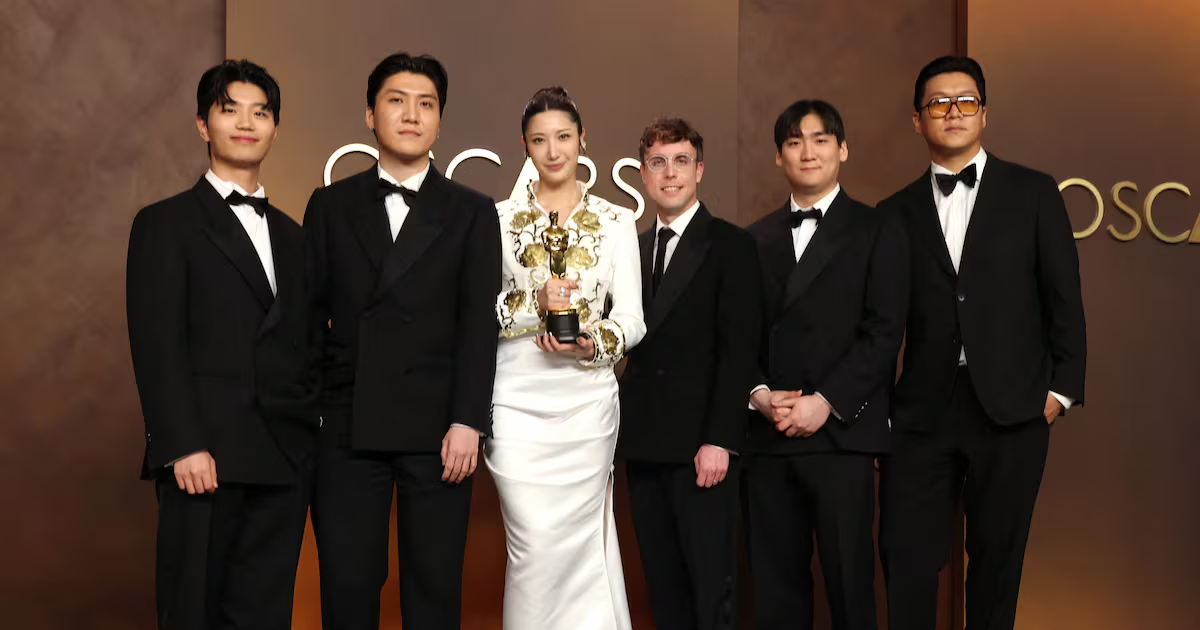
Despite the awkward end to the on-stage portion, the achievement stands tall. KPop Demon Hunters has already proven its staying power, with a sequel confirmed for 2029 and “Golden” continuing to resonate worldwide.
This Oscar win isn’t just about a trophy—it’s proof that bold, culturally rich storytelling from unexpected places can reach the highest levels of recognition. Congratulations to EJAE, the entire songwriting team, director Maggie Kang, and everyone who brought KPop Demon Hunters to life. History was made, even if the mic drop came a little too soon.